Best Vibe Coding Course in Kerala: How to Choose (2026)
By School of AI Team ·
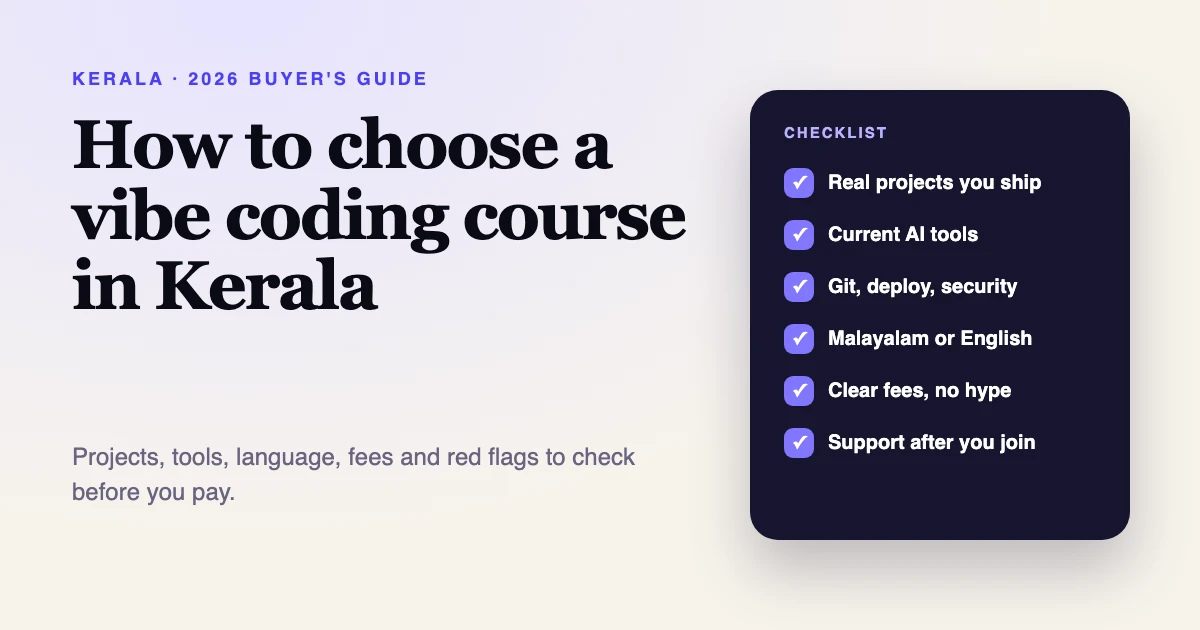
The best vibe coding course in Kerala gets you to ship real, working projects with current AI tools. It also teaches you to check, version and secure what the AI writes. A course that only shows you how to type prompts into a chatbot will leave you stuck the first time the code breaks. Use the eight checks below to compare any course, online or offline, in Malayalam or English, before you pay. School of AI publishes this guide and sells a vibe coding course; we rate our own course against the same checklist near the end.
What is vibe coding, and what should a course teach?
Vibe coding means describing what you want in plain language and letting an AI model write the code. AI researcher Andrej Karpathy coined the term in February 2025. He described a style where you “fully give in to the vibes, embrace exponentials, and forget that the code even exists” (quoted by Simon Willison). In November 2025, Collins Dictionary named “vibe coding” its Word of the Year (News On AIR). For a longer introduction, read our guide What is vibe coding?
Willison draws a useful line: strict vibe coding is “building software with an LLM without reviewing the code it writes.” That is fine for a weekend experiment. It is not enough for a website that takes payments or an app other people install. A good course therefore teaches two things together:
- The fast part: turning an idea into screens and working code with tools such as Claude, Claude Code, Cursor or Google Antigravity.
- The careful part: reading what the AI produced, saving versions with Git, testing, deploying, and fixing problems when the AI gets it “almost right.”
If a course syllabus only covers the first part, keep looking.
Why learn vibe coding in Kerala now?
AI coding tools are now the normal way software gets written. In the Stack Overflow Developer Survey 2026, 73% of respondents said they use coding assistants and agents daily (Stack Overflow 2026). Google's DORA research found that 90% of respondents use AI at work (DORA 2025 report).
India is at the centre of that shift. GitHub counted 21.9 million developers in India in 2025, up from 4.5 million in 2020, and projects 57.5 million by 2030 (GitHub Octoverse 2025). These are GitHub accounts, not jobs, but they show how fast the pool of people building software is growing.
Employers want these skills too. A Deloitte and NASSCOM report projected that demand for AI talent in India will grow from 600,000–650,000 to more than 1,250,000 during 2022–27 (Deloitte India). Closer to home, the Kerala government reports 5,000+ startups and 63+ incubators in the state (Invest Kerala 2025). For a student in Thrissur, a shop owner in Kozhikode or a founder in Kochi, the practical upside is simple: you can build and test your own website, booking system or app idea without waiting for a developer.
The 8-point checklist for choosing a vibe coding course
Run every course you are considering through these eight checks. A strong course passes at least six. A course that fails any of the first four is not worth the fee, however good the advertising looks.
1. You ship real projects that live on the internet
Ask what you will have at the end. A good answer names concrete outputs: a portfolio site on your own domain, a working web project, a mobile app you can install, a final project built from idea to launch. A certificate of completion is not an outcome. Projects you can share in a job application or show a client are.
2. The tools are current and taught as a workflow
AI coding tools change every few months. In the 2026 Stack Overflow survey, Claude Code (66%) and GitHub Copilot (59%) led among developers using coding agents (Stack Overflow 2026). A syllabus built around tools nobody uses any more is a warning sign. A course that only teaches buttons in one tool will also age fast. Look for a workflow you can carry across tools: plan the idea, design the screens, build with AI, test, fix and deploy.
3. Git, version control and deployment are included
Check this one closely. DORA's 2025 research found that AI adoption continues “to have a negative relationship with software delivery stability.” It adds that without “strong automated testing, mature version control practices, and fast feedback loops, an increase in change volume leads to instability” (DORA 2025 report).
In plain terms: AI lets you change code faster, so you need Git and GitHub to undo mistakes. You also need a deployment step, such as Vercel or Firebase, to put your work online. Check that both appear in the syllabus by name.
4. Security and code review are taught, not skipped
AI code can look perfect and still be unsafe. In Veracode's 2026 tests, AI models produced syntactically correct code almost every time. Yet the average security pass rate was only 56%, “virtually unchanged since last year's report” (Veracode 2026). Pass rates ranged from 63% for Python down to 30% for Java.
Veracode tested raw models without security prompts, so treat this as a lab result, not a measure of every app. It still shows why a course must cover basics such as keeping API keys secret, checking logins and validating form input.
Developers already know this. In the 2025 Stack Overflow survey, 46% said they distrust the accuracy of AI tools, against 33% who trust it. And 66% named “AI solutions that are almost right, but not quite” as their top frustration (Stack Overflow 2025). A course that teaches you to spot “almost right” code is worth more than one that promises AI will do everything.
5. The language matches how you learn
If you think in Malayalam, explanations in Malayalam can make new concepts easier to follow, even though the tools and code are in English. If you are comfortable in English, an English course keeps you closer to the documentation, error messages and AI prompts you will use. Both work. Check whether the course offers Malayalam explanations, English, or both, and watch a free sample lesson before deciding. (If you prefer Malayalam, see our vibe coding course in Malayalam.)
6. The format fits your time
If you work or run a business, self-paced recorded lessons let you learn after hours. If you need structure, a live cohort with fixed class times may keep you on track. Some people learn best in a classroom in Kochi, Thiruvananthapuram or Kozhikode. The table below compares the common formats.
| Format | Best for | Watch out for |
|---|---|---|
| Self-paced online (recorded) | Working people, flexible schedules, revising lessons | You need self-discipline; check how doubts get answered |
| Live online cohort | Learners who want deadlines and live Q&A | Fixed timings; recordings may expire after the batch ends |
| Offline institute | People who learn best in a classroom | Travel time; fees vary, so get them in writing; syllabus may lag new tools |
| One-day workshop or community event | Trying vibe coding before committing | Too short to ship a full project |
Community events are a low-cost way to try vibe coding before paying for a full course. For example, GDG Cloud Kochi ran a vibe coding session, “Vibe it Out”, at Kerala Startup Mission in Kochi in December 2025.
7. The fee and refund policy are clear
There is no reliable public data on what vibe coding courses cost in Kerala, so compare courses directly. A trustworthy course shows its fee on the page. It says whether you pay once or by subscription, and what happens if you want a refund. If a sales page hides the price behind a “talk to a counsellor” form, ask for the fee, any EMI interest and the refund terms in writing before you share payment details.
8. Every big claim can be checked
“Placement assistance,” “mentors from top companies” and “100% job guarantee” are easy to write and hard to prove. Ask for specifics: how many learners from the last batch got jobs, at which companies, and whether you can speak to one of them. Ask who the instructor is and what they have built. If the answers are vague, treat the claims as advertising.
Red flags to avoid
- No projects in the syllabus, only lists of tools or “prompt engineering tips.”
- No mention of Git, GitHub or deployment. You will build things you cannot save or share.
- No security or testing content at all.
- Outdated tools or a syllabus that reads like it was copied from an unrelated course.
- Hidden fees or pressure to pay today for a “limited seat” discount.
- Job guarantees without names, numbers or contactable alumni.
Questions to ask before you pay
- What exactly will I have built and published by the end?
- Which AI tools are taught, and when was the syllabus last updated?
- Are Git, GitHub, deployment and basic security covered?
- Is it taught in Malayalam, English or both? Can I watch a sample lesson?
- Is access lifetime or time-limited? Do I get future updates?
- How do I get help when my code breaks?
- What is the total fee, and what is the refund policy?
Where the School of AI masterclass fits
Full disclosure: this guide is published by School of AI, a Kerala-based online learning platform, and we run a vibe coding course. Here is how our Vibe Coding Masterclass measures against each check above:
- Projects (1): a personal portfolio, a complete website published on a domain, a Flutter mobile app for Android and iPhone, and a final project from idea to deployment.
- Tools (2): Claude, Claude Code, Google Antigravity, Google Stitch, VS Code and Flutter, taught while you build.
- Git and deployment (3): Git and GitHub are taught in the first web project, which you publish on a domain. Firebase and Vercel are among the course tools.
- Security (4): one module covers basic security checks. It is an introduction, not a full security course.
- Language (5): lessons are available with Malayalam explanations.
- Format (6): self-paced recorded video lessons online. There are no live classes.
- Fee (7): ₹1,999 as a one-time payment with lifetime access, including future module updates. For refund terms, email support@schoolofai.so before you pay.
- Help: 1-on-1 doubt support on WhatsApp, email support with replies within 24 hours (Monday to Saturday), and lifetime access to the School of AI builder community.
- Claims (8): we do not offer job placement or guarantees.
If you need live classes or placement support, a live cohort or an offline institute may suit you better. The full syllabus is on our Kerala course page.
Frequently asked questions
Do I need coding experience to join a vibe coding course?
No. Beginner-level courses are usually designed for people without a programming background; check the stated prerequisites. You will still learn to read code at a basic level, because checking what the AI writes is part of building anything reliable.
Is vibe coding worth learning if AI keeps changing?
Yes, if the course teaches a workflow rather than one tool. Planning, designing, building, testing, version control and deployment stay the same when the AI tools change. In the Stack Overflow 2026 survey, 48% of respondents said they trust AI when they can easily validate the answers. Learning to validate is exactly what a good course builds.
Can I learn vibe coding in Malayalam?
Yes. Some Kerala courses, including ours, offer Malayalam explanations, so ask any course for a sample lesson in the language you prefer. The tools, code and AI prompts stay in English, so expect to work with English terms even in a Malayalam course.
Online or offline: which is better in Kerala?
It depends on your schedule. Self-paced online courses suit people with jobs or businesses. Live or offline classes suit learners who need fixed timings. What matters most is whether you finish with real, published projects.
Sources
- Simon Willison, “Not all AI-assisted programming is vibe coding (but vibe coding rocks),” 19 March 2025: simonwillison.net
- News On AIR, “Vibe coding named Collins Dictionary's Word of the Year 2025,” 6 November 2025: newsonair.gov.in
- Stack Overflow Developer Survey 2026, AI section, 30,903 responses, released October 2026 (retrieved 2026-10-24): survey.stackoverflow.co
- Stack Overflow Developer Survey 2025, AI section, 49,009 responses: survey.stackoverflow.co
- Google Cloud, “Announcing the 2025 DORA report,” September 2025, nearly 5,000 respondents: cloud.google.com
- GitHub, Octoverse 2025, October 2025: github.blog
- Deloitte India and NASSCOM, AI talent gap report press release, August 2024: deloitte.com
- Government of Kerala, Invest Kerala Global Summit 2025, Innovation and Startups (retrieved 2026-10-24): investkerala2025.kerala.gov.in
- Veracode, 2026 GenAI Code Security Report press release, 28 July 2026: veracode.com
- GDG Cloud Kochi, “Vibe it Out” event listing, December 2025: gdg.community.dev
About this guide
This guide was written by the School of AI team, which builds and teaches the Vibe Coding Masterclass. Statistics were checked against the primary sources listed above on 24 October 2026. We will update the guide when the facts it relies on change. Spotted an error? Contact us through our support page. Or visit the School of AI homepage.